
Tolland County Arrest Warrants Explained
An arrest warrant is permission from a judge. It lets officers take a named person into custody once sworn facts establish probable cause, meaning a reasonable basis to think an offense happened and that this person took part. The charge still has to be proved in court. In Tolland County, the trial layer is the Connecticut Superior Court. Criminal Part B and motor-vehicle matters run through G.A. 19 in Rockville, while district-level functions sit in the Tolland Judicial District. Police investigate and serve warrants. The order itself, though, comes only from an authorized judge or judicial officer. Agency-side warrant information lives in PRAWN, which the public cannot search by name.
Tolland County Probable-Cause Warrant Path
The Tolland County path runs in stages: investigation, a complaint or sworn affidavit, prosecutorial application where required, judicial review, a signature or a denial, central-system entry, service, booking, and presentation in court. Each stage leaves a different record behind. An investigation file is not the same thing as a signed Tolland County arrest warrant. And service does not end the prosecution underneath it.
- The responsible police agency investigates the alleged offense.
- An officer prepares a complaint, affidavit, or other sworn facts.
- The application reaches an authorized Connecticut judicial officer.
- The judge decides whether probable cause supports issuance.
- Approved process enters connected court and agency systems.
- Police or another proper officer attempts service and reports the outcome.
- After custody, release conditions and the criminal case proceed separately.
Knowing the sequence helps a reader ask for the right document in Tolland County rather than a vague request for everything at once.
Inside a Tolland County Arrest Warrant
One open Tolland County arrest-warrant record can hold court, allegation, process, service, and release fields all at once. What you may see depends on timing, sealing, redaction, and juvenile rules.
| Court and docket | The Connecticut Superior Court venue and case identifier. |
|---|---|
| Warrant type | The precise arrest process ordered by the judge. |
| Issue date and officer | The judicial action and issuing authority. |
| Complaint or affidavit | Sworn probable-cause material, when open to inspection. |
| Charge and statute | The alleged offense and legal citation, not a finding of guilt. |
| Serving agency | Municipal police, State Police, or another proper officer. |
| Bond or release term | A case-specific condition if set and publicly available. |
| Status or return | Entry, service, return, recall, or other recorded action. |
Skip third-party summaries of Tolland County arrest warrant contents. Confirm the live court transaction and the agency's own status instead.
Tolland County PRAWN and Public Dockets
The Paperless Arrest Warrant Network serves authorized justice agencies only. It takes in data through CRMVS and related state systems and supports inquiry, service, and custodial processing. No public name search exists there, and the official system overview spells out that restricted design for Tolland County readers and everyone else.
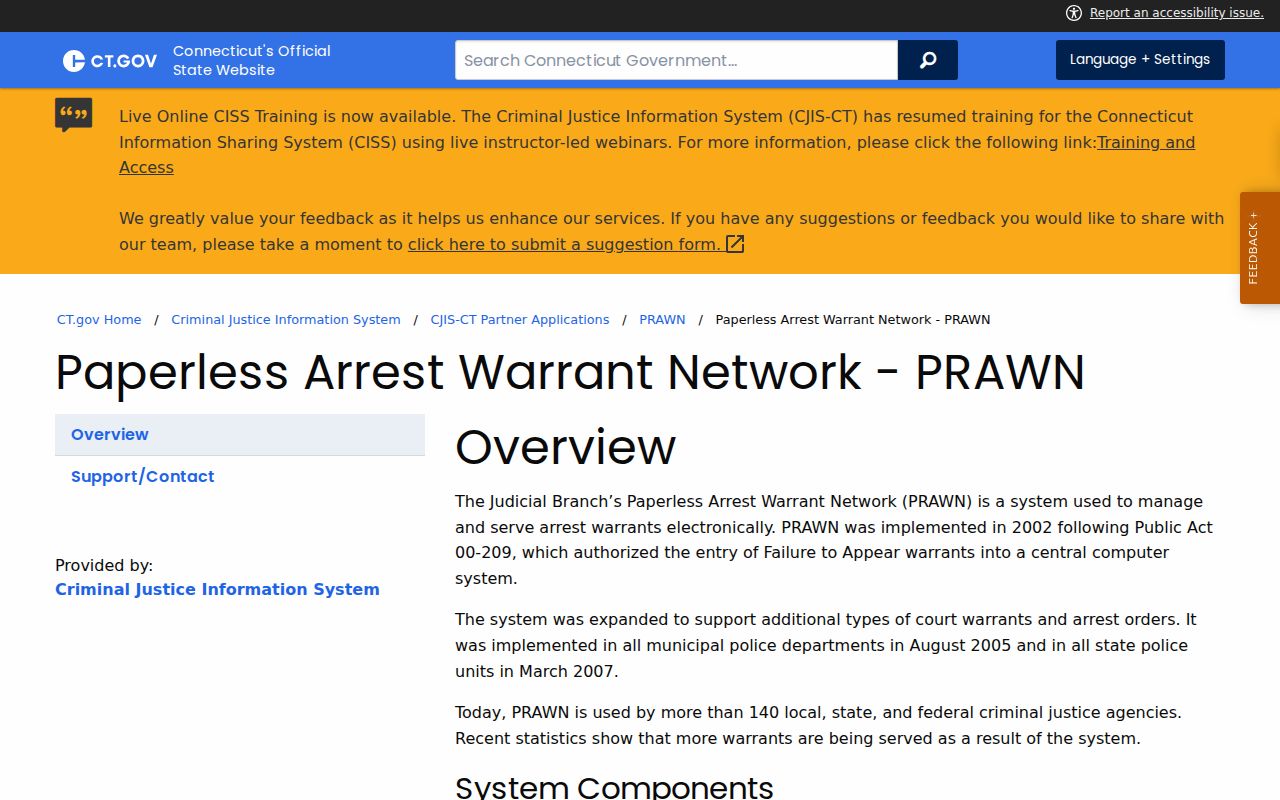
A Tolland County resident should go through public routes instead: the Judicial Branch criminal case lookup, the G.A. 19 clerk, the responsible police department, or a focused public-record request. A docket with no warrant flag still cannot rule out a recent, sealed, juvenile, or agency-only entry.
Serving Arrest Warrants in Tolland County
Who serves a warrant depends on the town and the agency assigned there. Vernon and Coventry run their own police departments. Mansfield, Ellington, Tolland, and many other towns rely on resident troopers or Connecticut State Police coverage, and Troop C in Tolland answers at 860-896-3200. Judicial marshals keep courthouses secure and handle assigned judicial functions. Connecticut's old county sheriff structure supplies no Tolland County warrant unit. State marshals serve certain civil process, including civil capias, but that is not criminal warrant service. Federal warrants run through the U.S. District Court and the U.S. Marshals, apart from the state public criminal lookup. The responsible agency can see PRAWN fields the public cannot. Ask that office how it confirms a person's own matter, and which unit holds it.
Tolland County Arrest Records After Service
Under C.G.S. §1-215, a record of arrest is generally public from the moment of arrest. When the arrest came by warrant, the record can include the application and affidavit, subject to redactions, sealing, and other law. Access before service works differently. Material may stay sealed so release would not frustrate enforcement in Tolland County.
Access begins with the legal status of the record.
Juvenile files are generally confidential under C.G.S. §46b-124. Witness details, investigative techniques, and information that could prejudice a prospective action may also be withheld.
Send a Connecticut FOIA request to the office that holds the specific record. Name the date range, town, docket, and document you want. FOIA is a records tool, not instant Tolland County arrest warrant confirmation.
Comparing Arrest, Summons, and Bench Warrants
These Tolland County processes are not one label. Each starts differently and calls for a different response.
| Process | What starts it | Immediate effect |
|---|---|---|
| Arrest warrant | Probable-cause allegations reviewed by a judge | Authorizes custody |
| Summons | Charging process directing court attendance | Requires appearance without being the same arrest order |
| Bench warrant | Judicial process tied to a court obligation or application | Can authorize custody and return to court |
| Capias or rearrest | Appearance-order or release-related issue | Brings the person back before the court |
A Tolland County docket may use one of several exact terms. Ask the criminal clerk to read the controlling entry. That beats trusting a label from an old notice or hallway talk.
Tolland County Arrest Warrant Service Routes
Call the court before guessing who holds the process. G.A. 19 at 20 Park Street in Rockville covers criminal Part B, misdemeanors, infractions, and motor-vehicle matters for the county's thirteen towns; its criminal clerk line is 860-870-3200, and criminal caseflow is listed at 860-870-3263. The district clerk at 69 Brooklyn Street routes district matters at 860-896-4920. Once the controlling town is known, use the agency's own route. Vernon Police records answers at 860-872-9126, option 5, and Coventry Police uses 860-742-7331. Troop C and the resident-trooper office cover State Police towns in Tolland County. The official county police contact sheet maps the rest.
If There's an Arrest Warrant for You
Talk to a defense lawyer before you appear anywhere. In Tolland County, make that call first. If you qualify for a public defender, G.A. 19 lists one at 860-870-3280. Counsel can seek a court date, ask the Tolland County judge to recall or quash the warrant where the law allows, or plan a surrender. Confirm whether a Tolland County judge set a bond and what court event follows custody. Before you act, the docket, the agency holding the warrant, and the Tolland County court should all point the same way, since procedure stays tied to the live case.
Do not rely on an unplanned walk-in.
No official Tolland County source guarantees an arrest-free visit, same-day recall, standard surrender window, or universal warrant bond amount.
- Confirm the process, docket, issuing court, and responsible agency.
- Discuss court and surrender options with counsel.
- Confirm destination, time, identification, booking, and court presentation.
- Verify any bond amount, type, payee, and accepted payment.
- Keep the receipt or new notice and confirm the updated court status.
In Tolland County, posting bond only addresses release; the charge stays open, and later court dates still stand.
Tolland County Arrest Warrant and Bond
Connecticut law lets a judge set the conditions of release, and state statutes cover how bail is accepted and when it may be forfeited. The amount and type vary case by case. Tolland County publishes no current arrest-warrant bond schedule. There is also no jail bond window, no warrant payment portal, and no guaranteed timing for court presentation. Ask G.A. 19 or counsel what the record shows. It may list a cash bond, surety bond, personal recognizance, another condition, or a hold that requires judicial review. Confirm who may accept payment. Get a receipt. A prior failure to appear can bring forfeiture, rearrest, or capias process, so every new court date matters. For further steps, see handling a Tolland County warrant. After service or release, verify the underlying case schedule. A warrant shown as served does not end the criminal case.